
Fare Capping and Tap to Pay are coming SOON!
With Fare Capping and tap to pay coming this fall, we wanted to get as much information in your hands to be prepared, and take advantage of these NEW, easy ways to pay, and get the best deal every time!
What is Fare Capping?
Fare capping ensures you never overpay for your rides. Once your individual trips add up to the cost of a daily or monthly pass, all additional rides for the rest of that period are completely free. It rewards you for riding more without requiring you to pay for a pass upfront.
- Daily Cap ($3.00): Once you spend $3.00 in a single service day, you have earned a Day Pass. Ride free for the rest of the day.
- 31-Day Cap ($40.00): When your total fares hit $40.00 within a rolling 31-day window, you ride free for the remainder of those 31 days.
- Peak & Off-Peak: Every dollar counts. No matter the time of day or the specific fare charged, every cent goes directly toward earning your free rides.
Three Easy Ways to Ride and Save!
Choose the method that best fits your lifestyle to start earning rewards automatically.
Option 1: The MyDTA Mobile App
- How it works: Download the free MyDTA app (available on iOS and Google Play) and load funds digitally. Scan your mobile ticket on the JustRide validator when boarding.
- Best for: Riders who already love using their smartphones for tickets and scheduling.
Option 2: Tap to Pay with Your Smart Device or Bank Card
- How it works: Tap your own contactless debit/credit card, smartphone, or smartwatch directly at the validator.
- Important: To make sure these taps count toward your Fare Capping rewards, you must first link your payment card or mobile wallet to your MyDTA app account.
Option 3: The Physical “More Card”
- How it works: Visit the customer service window at the Duluth Transportation Center (DTC) to pick up a card. It is completely free when you load your first $5.00.
- Best for: Riders who prefer using cash or want a worry-free experience without sharing personal banking info.
Frequently Asked Questions
Are there any extra hidden fees?
No. The MyDTA app is free to download, and the “More Card” is free with a minimum $5.00 starting balance.
Can I use my card or app to pay for a friend or family member?
No. To prevent abuse, validators reject duplicate taps made in quick succession (“pass-backs”). Think of fare capping as tracking your physical rides, not just the money spent. To cover a travel companion, you should load funds onto their own separate card or app account ahead of time.
Can I manage my child’s account from my phone?
Yes! You can set up a shared family account in the MyDTA app. This allows you to view and reload your child’s card from your login. However, their physical card will still track its own independent progress toward daily and monthly caps.
Where do I add cash to my “More Card”?
You can load funds at the DTC customer service window or at participating VanillaDirect retail locations. (Link to Interactive Map)
Can I transfer my balance from an old paper or traditional Prox-card?
Yes. Bring your old transit cards to the DTC customer service window, and our team will gladly transfer your existing balance onto a new “More Card” so you can start earning rewards.
Are traditional paper and Prox-cards being discontinued?
Not right away. We will continue evaluating our older ticket styles after launch. If we decide to phase them out down the road, we will provide a generous grace period to ensure everyone can use up their balances or transfer them over.
If I choose to purchase multiple tickets at one time, will they all count towards my personal fare-capping tally for the day or 31-day period?
Just the first ticket will count. The system tracks rides taken, not money spent. Every tap of your own card counts toward your personal day/monthly total. Paying for someone else doesn’t add toyour own tally, because it’s tied to your card actually being tapped for your own trip. There’s also a short, built-in delay before the same card can be tapped again, specifically to prevent one card from being used to wave multiple people through.
Tap to Pay: Secure, Easy, and Fast!
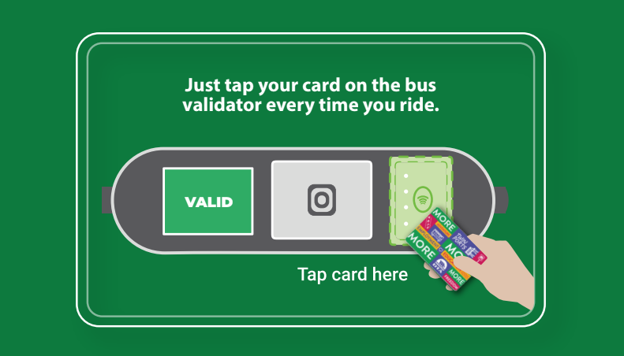
Use your Physical Debit or Credit Card or Digital Wallet to Pay your fare.
More Details:
Contactless tap-to-pay lets you pay for public transit using your own contactless bank card, smartphone, or smart device. Every tap generates a unique, one-time security code. The DTA never sees, stores, or shares your personal banking details, and your data is fully protected by global financial network security standards.
Security and Privacy
- Encrypted Data: Every tap creates a unique, dynamic one-time security code.
- No Stored Info: Transit operators do not see, store, or share your personal bank details.
- Fraud Protection: Backed by standard global financial network liability rules.
Fares, Limits, and Charges
- Standard Cost: Taps usually cost the exact same as a standard adult single cash or base ticket.
- No Extra Fees: Transit agencies generally do not charge extra service fees to tap.
Can I use EMV/Tap to Pay with a gift card?
Gift cards are not equipped with the technology to allow for fare capping to function. Debit or credit cards (physical or digital wallet versions) are all great options.
How can I go about getting the EMV/Fare capping set up with physical or digital credit/debit card? Is it as simple as setting up an account through Masabi and connecting a card?
Yes, here are the details:
- Tap any contactless debit, credit, or prepaid card. Fare capping starts working right away, no signup required.
- To see your trip history and charges, create or log into a MyDTA account.
- In your account, add your card by entering the card number, expiry date, CVV, and billing zip code.
- Ride again using that same card and it will then show up in your account.
If I choose to use fare capping with Tap to pay, will it automatically tie to my MyDTA account when I scan a displayed card? Does a digital visual version end up in my mobile wallet?
Fare capping itself works automatically on any contactless bank card from the very first tap, no account or app is needed. Linking that card to a MyDTA account is a separate step done in the app or on the website: you can enter your card number, expiry date, CVV, and billing zip code, and the card shows up in your account after it’s been tapped for a real ride.
The Value of Fare Capping:
1. Enhances Social Equity & Financial Inclusion
Traditionally, public transit agencies offer discounted “unlimited passes” (e.g., a $40 monthly pass). However, low-income riders often cannot afford the steep upfront cost. Instead, they pay per ride, unintentionally paying more over time than wealthier commuters.
- Removes the Upfront Cost Barrier: Fare capping acts as a financial safety net. It allows passengers to “earn” a weekly or monthly pass incrementally without paying upfront.
- Equalizes Discounts: It ensures that all community members receive the same volume-based discounts, regardless of their immediate cash flow.
2. Reduces Travel Stress and Decision Fatigue
Navigating transit fare structures can be confusing for daily commuters, occasional riders, and tourists alike.
- Elimination of Guesswork: Riders do not have to guess how many trips they will take or worry about wasting money on an unlimited pass they might not fully utilize.
3. Speeds Up Commutes (Reduced Boarding Times)
Fare capping relies on electronic validation like tap-and-go cards or mobile payment apps.
- Faster Boarding: Because passengers do not need to fumble for exact cash change, buy paper tickets from a machine, or speak with the driver, bus and train boarding times drop drastically.
- Improved On-Time Reliability: Faster boarding leads to shorter dwell times at stops, resulting in faster and more predictable trips for everyone on board.